USING LIFE AS A RESOURCE IN MAGIC Life is the most overlooked resource in Magic. Players usually swear only by card advantage, board advantage, creature advantage, or mana advantage. Very rarely do players discuss the concept of life advantage or conservation of life points. Talk to a good player and they will tell you that it is better to take damage than lose card advantage. This is not wrong at all. Who cares if you are at one life, as long as your opponent is at zero? That is what we usually think, but when in very precise situations, inflexibly chosing card or board advantage over life advantage is not always the way to go. I have seen players who are experts in card advantage still lose games to other factors. My own play style is also suspect: I often outthink myself in terms of "advantages" and lose games I could have won because of an unseen mistake. I just realized recently that I did not care enough about my life points. This all revolves around the basic rules of Magic. When you start the game, you have twenty life points ready and waiting to be depleted. You have no mana, and seven cards only. Gradually, as the game progresses, your life total is likely to go down, as well as your cards well as your cards in hand, while you struggle to gain board advantage and mana advantage. Now suppose you have cast a first turn Llanowar Elf. Your opponent attacks you with his Mogg Fanatic. Since you are a good player, you would not choose to block the Fanatic with your Elf, since this would be like destroying one of your lands! Getting rid of the Fanatic is not a priority right now, so staying at twenty life is certainly not going to be a priority itself. The choice would be even more obvious if your opponent was attacking with, say, a first turn Skittering Horror. Chump blocking on turn two is a poor choice. Take a look at more complicated situation. You have nine life in an Extended match while playing Forbidian (before the October bannings). You have a Forbid and another random card in hand with three blue mana available. Your opponent (playing mono red) draws and casts Ball Lightning. Now you face a tough strategic choice. To Forbid, or not to Forbid? That is the question. If you counter the Ball Lightning, your life total stays relatively safely at nine. That means you'll have at least a few more turnsast a few more turns to draw cards and try to take control. It also means that you lose the Forbid and the power of countering with buyback unless you draw another one soon. If you keep the Forbid and take six damage from the Ball Lightning, you go down to three life. At three versus a very offensive mono red deck, your margin for error is really restricted. You are within the range of a Lightning Bolt, a Fireblast, a Goblin Grenade, or an Incinerate. In fact, you are in trouble. You would be dead for sure, except you have the Forbid, and you have the capacity to counter with buyback on the next turn. The best play here is not obvious. You could argue that both choices are valid. But it really comes down to a choice between life margin and card margin. In that situation, you have to evaluate which potential choice is the most disastrous, and avoid it. You have to calculate the odds and decide. Tons of factors are to be taken into consideration here: your opponent's deck, his play style, the cards you have both already played, what is in his sideboard, what you are likely to draw and what he is likely to draw, playtesting information about the matchup... every single thing can be importanting can be important. Your life total must be evaluated, too. Of course, your opponent's life total also matters. I cannot say which I would choose, from the little information in my example. However, if I had to rely on matchup theory, I know that a red deck can burn me out even if I hold counterspells. Burn is cheaper, can be cast at the end of my turn, two Lightning Bolts and 6th Edition rules beat Forbid with buyback, for sure. With that train of thought, I would probably counter the Ball Lightning and keep my life total safe and out of range. In short, life is your margin. If you are at three life and your opponent Bolts you, you have no choice but to counter it or try to prevent it. If you're at four life, you have an additional choice: to take the damage. It is always better to have options. This is very true in limited formats, where you usually have to calculate waves of attackers. The higher your life is, the less defense you have to keep back when you launch an attack. For example, at two life, you will have to keep enough blockers to prevent every one of your opponent's two-power-or-higher creatures from hitting you.
So what am I saying here? Defend your life and scorn card advantage?
Sometimes, life matters more than cards. If your opponent attacks you with a
Winding Wurm and you are at ten life, are you going to take the risk of going down
to four life and being unable to attack? Or would you block with that silly 1/1 you have had
in play for ages? In that kind of situation, sacrificing a "useless" card is
definitely worth it, unless you could use it to beat your opponent down to 0
first.
The converse of this situation is also true. Attack your opponent's life total! The less life
he has, the fewer options he has. If you can damage your opponent more
than he can damage you back, go for it! If the worst that can happen is that you
both trade equal damage, it
does not matter that much, because you are controlling the game. Be
aggressive, start attacking whenever it is a possibility. Don't hold back your
offense fearing some unknown trap. If there is a trap, such as Simian Grunts
or Rock Slide, you'll have to deal with it anyway later in the game. Your opponent
might be bluffing, too, and then you'll regret these two critical points of damage you
chose not to inflict.
Keep in mind this is all theory. There are countless variables in a gss variables in a game of
Magic that can influence your decisions. Theoretical strategy is risky, as
reality is often far different. The sole point of my article
is to remind you: do not forget your life advantage, because it is just
as crucial as any other kind of advantage in Magic.
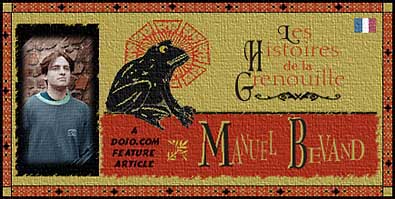
Frenchman and Team Legion Member Manuel Bevand (AKA "The Frog/Grenouille") has been writing regularly for the Dojo for over three years.
His Professional tournament record includes: Second Place at the 1998 World Championships Team Event,
Second Place at the 1998 French Nationals, Top 8 at the 1999 French Nationals, Third Place at Grand Prix Lyon,
Fifth Place at Grand Prix Stockholm, and Ninth Place at Grand Prix Como.
|